
BOOK REVIEW
Narcissus and Goldmund
Laura Schäfer
Behind the cloistered walls of the Mariabronn monastery, a German monastic school, Narcissus, a young monk, pursues a life of extreme discipline and abstinence, an exemplary teacher amidst their ranks. Withdrawn from the world’s chaotic nature, he lives in a carefully reasoned edifice of spiritual commitment, a life governed by prayer bells, meditation, and intellectual pursuits. Into this sanctuary arrives ardent Goldmund, a student imbued by his father with an ambition to pursue this same sacred path, developing a natural admiration for Narcissus. These two characters portray the inherent duality that we find in ourselves.
In establishing the contrast between the thinker and the artist, Hesse carves out two symbols of human identity. Narcissus is the paragon of the paternal path, distilling meaning through rigorous intellectual contemplation. He has surrendered to his nature through the abstinence and discipline required by his path. Goldmund lies on the other side, the epitomical symbol of the maternal path, where meaning is derived through immersion in life’s immediate intensity. His acute sensual awareness seeks to plunge into the free, raw experience of existence.
These inherent differences materialize into opposing needs: Narcissus requires detachment and tranquillity, Goldmund engagement and fervour. One is grounded in ideas and axioms, the other in earth and sensations. This dichotomy reflects our own inherent duality, allowing Hesse to explore human identity. It is a meditation on how to reconcile our complementary nature, the Goldmund and the Narcissus that lies within us, the eternal question of which to nurture, of how to live. Narcissus says to Goldmund:
"Natures of your kind, with strong, delicate senses, the soul-oriented, the dreamers, poets, lovers are almost always superior to us creatures of the mind. You take your being from your mothers. You live fully; you were endowed with the strength of love, the ability to feel. Whereas we creatures of reason, we don't live fully; we live in an arid land, even though we often seem to guide and rule you. Yours is the plenitude of life, the sap of the fruit, the garden of passion, the beautiful landscape of art. Your home is the earth; ours is the world of ideas. You are in danger of drowning in the world of the senses; ours is the danger of suffocating in an airless void. You are an artist; I am a thinker. You sleep at the mother's breast; I wake in the desert.”
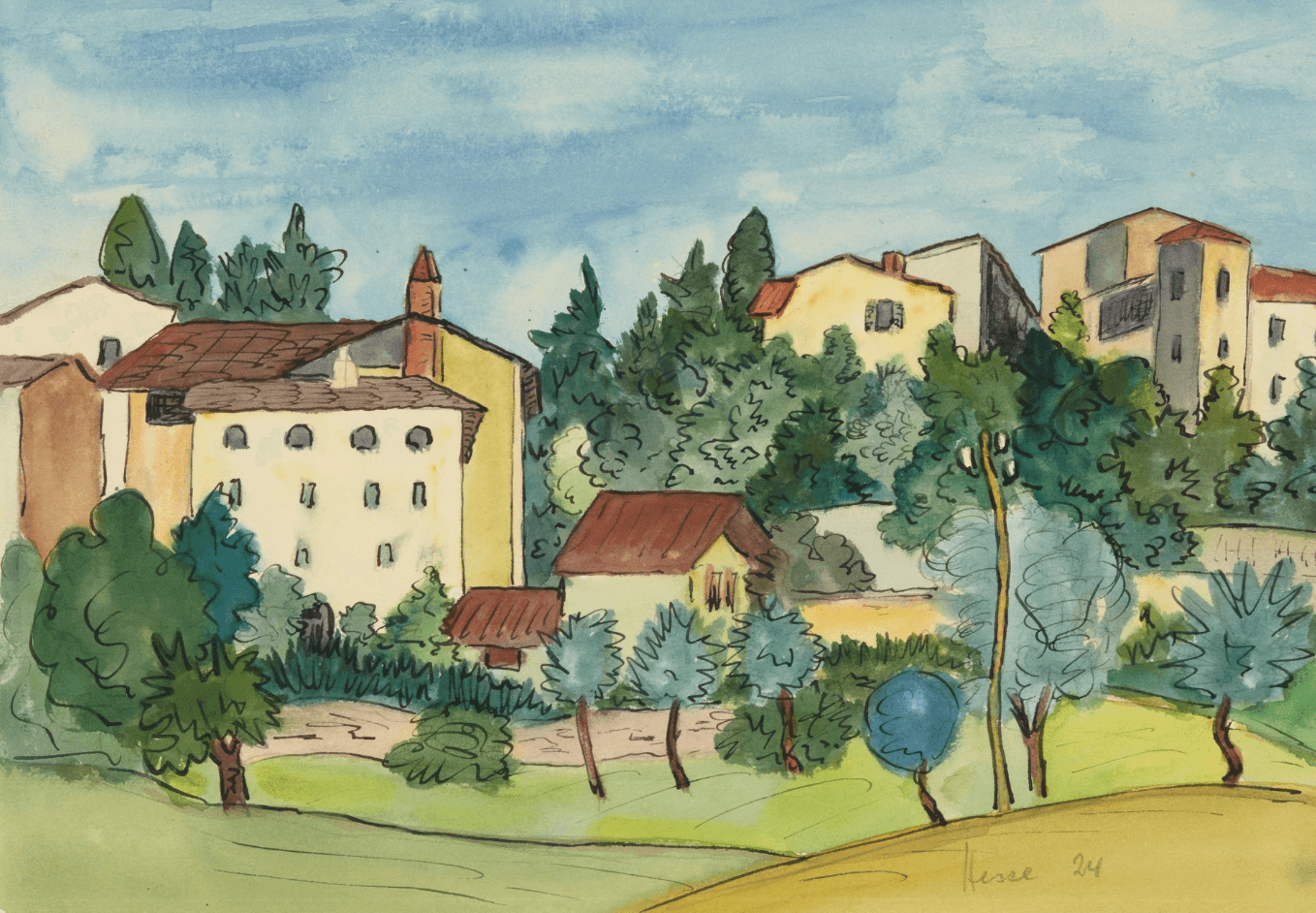
Gentilino, by Hermann Hesse, 1924
Once awakened to his authentic nature, Goldmund plunges into the chaotic undercurrents of reality, wandering highways and forests, enduring physical hardship, and embracing both the ecstasies and agonies that come from looking life in the eye. The great world had now become reality:
“Oh, how incomprehensible everything was, and actually sad, although it was also beautiful. One knew nothing. One lived and ran about the earth and rode through forests, and certain things looked so challenging and promising and nostalgic: a star in the evening, a blue harebell, a reed-green pond, the eye of a person or of a cow. And sometimes it seemed that something never seen yet long desired was about to happen, that a veil would drop from it all.”
Hesse thus remarkably develops a symbol of our maternal identities that cannot fall under the judgement and criticism of intellect. He skillfully elucidates the equality and merit that lies in a wayfaring education, disarming us of the “rational” criticisms founded on ridiculing such a life. This disarmament is further strengthened in the notion of the divine spark being preserved, that man can descend to the wretched basal of the underworld and still emerge unscathed and spilling with life itself:
“A man destined for high things can dip into the lowest depths of the bloody, drunken chaos of life, and soil himself with much dust and blood, without becoming small and common, without killing the divine spark within himself, that he can err through the thickest darkness without extinguishing the divine light and the creative force inside the shrine of his soul. Narcissus had looked deeply into his friend's chaotic life, and neither his love for him nor his respect for him dwindled. It had been easy for him to seem superior to Goldmund in their conversations, to oppose his discipline and intellectual order to his friend's passions. But was not every small gesture of one of Goldmund's figures, every eye, every mouth, every branch and fold of gown worth more? Was it not more real, alive, and irreplaceable than everything a thinker could achieve?”
Having disarmed the reader, almost as Narcissus disarms Goldmund, Hesse can finally invite his profound, long-awaited questioning of how we ought to live, a questioning that now puts freedom and discipline on equal footing.
BOOK REVIEW
Narcissus and Goldmund
Laura Schäfer
Behind the cloistered walls of the Mariabronn monastery, a German monastic school, Narcissus, a young monk, pursues a life of extreme discipline and abstinence, an exemplary teacher amidst their ranks. Withdrawn from the world’s chaotic nature, he lives in a carefully reasoned edifice of spiritual commitment, a life governed by prayer bells, meditation, and intellectual pursuits. Into this sanctuary arrives ardent Goldmund, a student imbued by his father with an ambition to pursue this same sacred path, developing a natural admiration for Narcissus. These two characters portray the inherent duality that we find in ourselves.
In establishing the contrast between the thinker and the artist, Hesse carves out two symbols of human identity. Narcissus is the paragon of the paternal path, distilling meaning through rigorous intellectual contemplation. He has surrendered to his nature through the abstinence and discipline required by his path. Goldmund lies on the other side, the epitomical symbol of the maternal path, where meaning is derived through immersion in life’s immediate intensity. His acute sensual awareness seeks to plunge into the free, raw experience of existence.
These inherent differences materialize into opposing needs: Narcissus requires detachment and tranquillity, Goldmund engagement and fervour. One is grounded in ideas and axioms, the other in earth and sensations. This dichotomy reflects our own inherent duality, allowing Hesse to explore human identity. It is a meditation on how to reconcile our complementary nature, the Goldmund and the Narcissus that lies within us, the eternal question of which to nurture, of how to live. Narcissus says to Goldmund:
"Natures of your kind, with strong, delicate senses, the soul-oriented, the dreamers, poets, lovers are almost always superior to us creatures of the mind. You take your being from your mothers. You live fully; you were endowed with the strength of love, the ability to feel. Whereas we creatures of reason, we don't live fully; we live in an arid land, even though we often seem to guide and rule you. Yours is the plenitude of life, the sap of the fruit, the garden of passion, the beautiful landscape of art. Your home is the earth; ours is the world of ideas. You are in danger of drowning in the world of the senses; ours is the danger of suffocating in an airless void. You are an artist; I am a thinker. You sleep at the mother's breast; I wake in the desert.”
Gentilino, by Hermann Hesse, 1924
Once awakened to his authentic nature, Goldmund plunges into the chaotic undercurrents of reality, wandering highways and forests, enduring physical hardship, and embracing both the ecstasies and agonies that come from looking life in the eye. The great world had now become reality:
“Oh, how incomprehensible everything was, and actually sad, although it was also beautiful. One knew nothing. One lived and ran about the earth and rode through forests, and certain things looked so challenging and promising and nostalgic: a star in the evening, a blue harebell, a reed-green pond, the eye of a person or of a cow. And sometimes it seemed that something never seen yet long desired was about to happen, that a veil would drop from it all.”
Hesse thus remarkably develops a symbol of our maternal identities that cannot fall under the judgement and criticism of intellect. He skillfully elucidates the equality and merit that lies in a wayfaring education, disarming us of the “rational” criticisms founded on ridiculing such a life. This disarmament is further strengthened in the notion of the divine spark being preserved, that man can descend to the wretched basal of the underworld and still emerge unscathed and spilling with life itself:
“A man destined for high things can dip into the lowest depths of the bloody, drunken chaos of life, and soil himself with much dust and blood, without becoming small and common, without killing the divine spark within himself, that he can err through the thickest darkness without extinguishing the divine light and the creative force inside the shrine of his soul. Narcissus had looked deeply into his friend's chaotic life, and neither his love for him nor his respect for him dwindled. It had been easy for him to seem superior to Goldmund in their conversations, to oppose his discipline and intellectual order to his friend's passions. But was not every small gesture of one of Goldmund's figures, every eye, every mouth, every branch and fold of gown worth more? Was it not more real, alive, and irreplaceable than everything a thinker could achieve?”
Having disarmed the reader, almost as Narcissus disarms Goldmund, Hesse can finally invite his profound, long-awaited questioning of how we ought to live, a questioning that now puts freedom and discipline on equal footing.
BOOK REVIEW
Narcissus and Goldmund
Laura Schäfer
Behind the cloistered walls of the Mariabronn monastery, a German monastic school, Narcissus, a young monk, pursues a life of extreme discipline and abstinence, an exemplary teacher amidst their ranks. Withdrawn from the world’s chaotic nature, he lives in a carefully reasoned edifice of spiritual commitment, a life governed by prayer bells, meditation, and intellectual pursuits. Into this sanctuary arrives ardent Goldmund, a student imbued by his father with an ambition to pursue this same sacred path, developing a natural admiration for Narcissus. These two characters portray the inherent duality that we find in ourselves.
In establishing the contrast between the thinker and the artist, Hesse carves out two symbols of human identity. Narcissus is the paragon of the paternal path, distilling meaning through rigorous intellectual contemplation. He has surrendered to his nature through the abstinence and discipline required by his path. Goldmund lies on the other side, the epitomical symbol of the maternal path, where meaning is derived through immersion in life’s immediate intensity. His acute sensual awareness seeks to plunge into the free, raw experience of existence.
These inherent differences materialize into opposing needs: Narcissus requires detachment and tranquillity, Goldmund engagement and fervour. One is grounded in ideas and axioms, the other in earth and sensations. This dichotomy reflects our own inherent duality, allowing Hesse to explore human identity. It is a meditation on how to reconcile our complementary nature, the Goldmund and the Narcissus that lies within us, the eternal question of which to nurture, of how to live. Narcissus says to Goldmund:
"Natures of your kind, with strong, delicate senses, the soul-oriented, the dreamers, poets, lovers are almost always superior to us creatures of the mind. You take your being from your mothers. You live fully; you were endowed with the strength of love, the ability to feel. Whereas we creatures of reason, we don't live fully; we live in an arid land, even though we often seem to guide and rule you. Yours is the plenitude of life, the sap of the fruit, the garden of passion, the beautiful landscape of art. Your home is the earth; ours is the world of ideas. You are in danger of drowning in the world of the senses; ours is the danger of suffocating in an airless void. You are an artist; I am a thinker. You sleep at the mother's breast; I wake in the desert.”
Gentilino, by Hermann Hesse, 1924
Once awakened to his authentic nature, Goldmund plunges into the chaotic undercurrents of reality, wandering highways and forests, enduring physical hardship, and embracing both the ecstasies and agonies that come from looking life in the eye. The great world had now become reality:
“Oh, how incomprehensible everything was, and actually sad, although it was also beautiful. One knew nothing. One lived and ran about the earth and rode through forests, and certain things looked so challenging and promising and nostalgic: a star in the evening, a blue harebell, a reed-green pond, the eye of a person or of a cow. And sometimes it seemed that something never seen yet long desired was about to happen, that a veil would drop from it all.”
Hesse thus remarkably develops a symbol of our maternal identities that cannot fall under the judgement and criticism of intellect. He skillfully elucidates the equality and merit that lies in a wayfaring education, disarming us of the “rational” criticisms founded on ridiculing such a life. This disarmament is further strengthened in the notion of the divine spark being preserved, that man can descend to the wretched basal of the underworld and still emerge unscathed and spilling with life itself:
“A man destined for high things can dip into the lowest depths of the bloody, drunken chaos of life, and soil himself with much dust and blood, without becoming small and common, without killing the divine spark within himself, that he can err through the thickest darkness without extinguishing the divine light and the creative force inside the shrine of his soul. Narcissus had looked deeply into his friend's chaotic life, and neither his love for him nor his respect for him dwindled. It had been easy for him to seem superior to Goldmund in their conversations, to oppose his discipline and intellectual order to his friend's passions. But was not every small gesture of one of Goldmund's figures, every eye, every mouth, every branch and fold of gown worth more? Was it not more real, alive, and irreplaceable than everything a thinker could achieve?”
Having disarmed the reader, almost as Narcissus disarms Goldmund, Hesse can finally invite his profound, long-awaited questioning of how we ought to live, a questioning that now puts freedom and discipline on equal footing.
Write a eulogy to something you love: contact@theneighborr.com
Write a eulogy to something you love:
contact@theneighborr.com