MUSIC
The Dissonance of Jazz
Raphael Touzelet
The first time I listened to jazz I was thirteen years old and I did not understand anything. Kind of Blue was the first album I played. Nothing was clear, the rare passages that harmonically conformed to my habits were quickly overtaken by some unpredictable dissonance. All of it formed an indecipherable chaos. I was definitively impervious to this music that enjoys such great prestige.
I was impervious to jazz, too bad. I thought about it for days. Fragments kept coming back to me: the opening double bass notes of Flamenco Sketches or the first three chords of Blue in Green. Until one day I decided, with genuine desire, to play the album again. For eight years now I've been listening to this album every month. The visceral rejection that jazz had provoked in me gave way to a passionate obsession. What had seemed dissonant and confused, I now experience as marvelous and virtuosic. I tried to understand what had happened, to understand why everything sounded so different. My search opened the door to dizzying questions and the beginning of an answer.
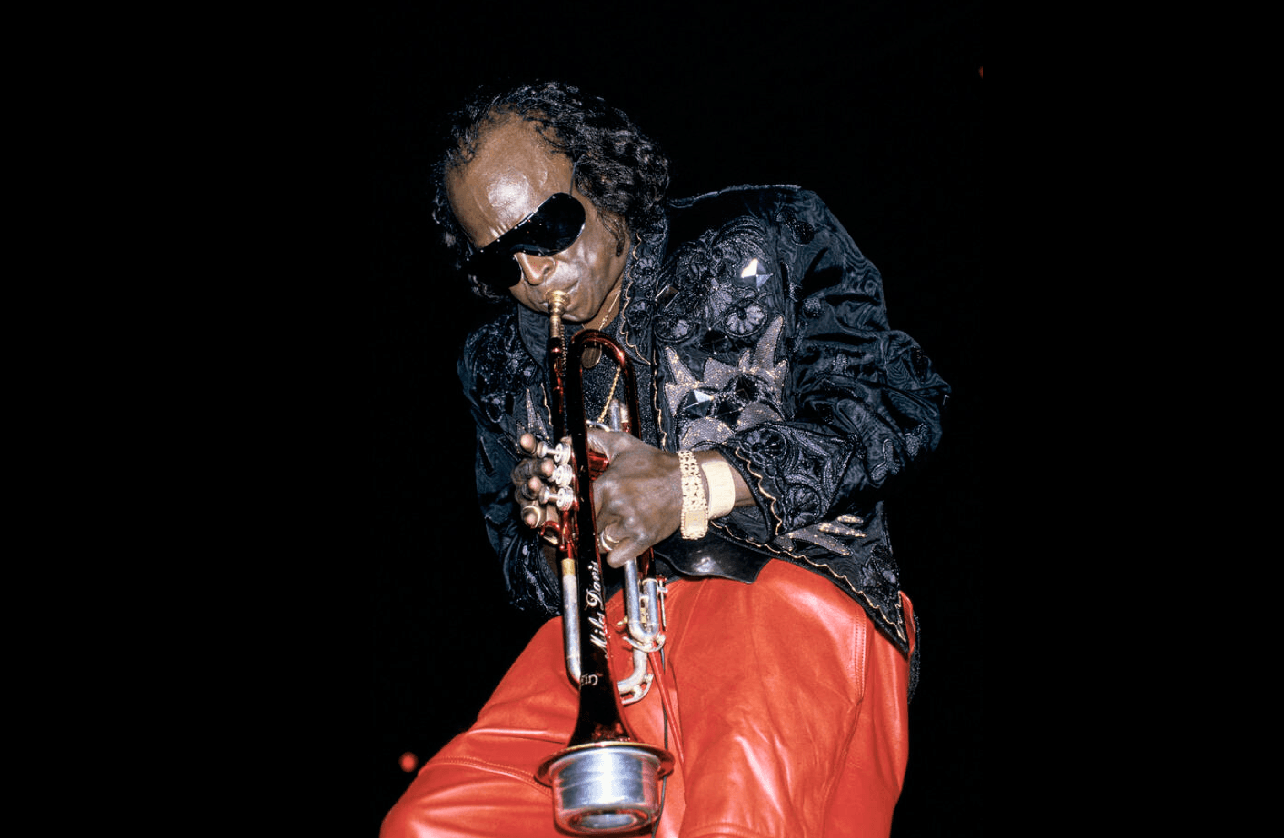
Miles Davis, Munich Concert
To borrow Bégaudeau's words, it's difficult to talk about music and our feelings toward it precisely because words always relate to images, and since music is nothing but sound, it is more abstract and thus escapes language. Western music theory proposes to study this art as an object, to describe it with concepts and sometimes to prescribe it with rules.
Music is made of notes, notes are sounds, sounds are vibrations in the air. The quantity of air vibration emitted by a note is its frequency, expressed in Hz (264 Hz for C, for example). Each sound emits a fundamental frequency and a cluster of other frequencies that are multiples of the fundamental (132, 396, 528 Hz for C, for example). A note alone means nothing, in the sense that it doesn't convey any particular emotion. It takes on meaning in context: the notes placed before and after it give it an emotion. A distance between two notes (played simultaneously or in succession) is called an interval.
For some impenetrable reason, the combination of several notes will sound more or less pleasing. G (396 Hz) and C (264 Hz) sound perfectly consonant (396 = 1.5 × 264) and give a sensation of satisfaction. Conversely, C (264 Hz) and C# (277 Hz) sound very dissonant, and create a sensation of tension. We'll note that the two notes follow each other on a keyboard. Music could be summarized thus: the art of producing and resolving tensions. The emotions that music gives us are rooted in the intervals between each note, these intervals are distances measured in "tones." Music is proportion.
When a composer writes a work, they are constrained by a scale. A scale is a collection of seven notes. It gives its color to a work. If in a work, you play a note that isn't part of its scale, the tension will be such that you can only firmly declare: it's a wrong note, it's unpleasant. The freedom of jazz is to regularly step outside the established scale. This is what we call borrowing. For a brief instant, the listener perceives a dissonance that creates tension, stress. This tension dissipates when the musician resolves it, returning to a stable scale through a satisfying interval.
The notion of a wrong note extinguishes itself: everything is just a question of context. It's this excitement that creates the thrill of this music. This transgression makes jazz works as colorful and free as paintings. The pictorial equivalent would be a canvas by Kandinsky or Miró. It's music that refuses form. Contemporary pop music is, for the most part, strictly diatonic. That is to say, it refuses to leave the scale, even for a brief instant. We more often associate a pop song with a vivid and assertive color. A commonplace is to say that pop is sweet where jazz is bittersweet. This difference is obviously reinforced by the structure of these two genres. Jazz is a music of improvisation, therefore unpredictable. Pop music consists of melodic phrases that we repeat. Listening to jazz is a listening that demands surrender, as before a painting.
MUSIC
The Dissonance of Jazz
Raphael Touzelet
The first time I listened to jazz I was thirteen years old and I did not understand anything. Kind of Blue was the first album I played. Nothing was clear, the rare passages that harmonically conformed to my habits were quickly overtaken by some unpredictable dissonance. All of it formed an indecipherable chaos. I was definitively impervious to this music that enjoys such great prestige.
I was impervious to jazz, too bad. I thought about it for days. Fragments kept coming back to me: the opening double bass notes of Flamenco Sketches or the first three chords of Blue in Green. Until one day I decided, with genuine desire, to play the album again. For eight years now I've been listening to this album every month. The visceral rejection that jazz had provoked in me gave way to a passionate obsession. What had seemed dissonant and confused, I now experience as marvelous and virtuosic. I tried to understand what had happened, to understand why everything sounded so different. My search opened the door to dizzying questions and the beginning of an answer.
Miles Davis, Munich Concert
To borrow Bégaudeau's words, it's difficult to talk about music and our feelings toward it precisely because words always relate to images, and since music is nothing but sound, it is more abstract and thus escapes language. Western music theory proposes to study this art as an object, to describe it with concepts and sometimes to prescribe it with rules.
Music is made of notes, notes are sounds, sounds are vibrations in the air. The quantity of air vibration emitted by a note is its frequency, expressed in Hz (264 Hz for C, for example). Each sound emits a fundamental frequency and a cluster of other frequencies that are multiples of the fundamental (132, 396, 528 Hz for C, for example). A note alone means nothing, in the sense that it doesn't convey any particular emotion. It takes on meaning in context: the notes placed before and after it give it an emotion. A distance between two notes (played simultaneously or in succession) is called an interval.
For some impenetrable reason, the combination of several notes will sound more or less pleasing. G (396 Hz) and C (264 Hz) sound perfectly consonant (396 = 1.5 × 264) and give a sensation of satisfaction. Conversely, C (264 Hz) and C# (277 Hz) sound very dissonant, and create a sensation of tension. We'll note that the two notes follow each other on a keyboard. Music could be summarized thus: the art of producing and resolving tensions. The emotions that music gives us are rooted in the intervals between each note, these intervals are distances measured in "tones." Music is proportion.
When a composer writes a work, they are constrained by a scale. A scale is a collection of seven notes. It gives its color to a work. If in a work, you play a note that isn't part of its scale, the tension will be such that you can only firmly declare: it's a wrong note, it's unpleasant. The freedom of jazz is to regularly step outside the established scale. This is what we call borrowing. For a brief instant, the listener perceives a dissonance that creates tension, stress. This tension dissipates when the musician resolves it, returning to a stable scale through a satisfying interval.
The notion of a wrong note extinguishes itself: everything is just a question of context. It's this excitement that creates the thrill of this music. This transgression makes jazz works as colorful and free as paintings. The pictorial equivalent would be a canvas by Kandinsky or Miró. It's music that refuses form. Contemporary pop music is, for the most part, strictly diatonic. That is to say, it refuses to leave the scale, even for a brief instant. We more often associate a pop song with a vivid and assertive color. A commonplace is to say that pop is sweet where jazz is bittersweet. This difference is obviously reinforced by the structure of these two genres. Jazz is a music of improvisation, therefore unpredictable. Pop music consists of melodic phrases that we repeat. Listening to jazz is a listening that demands surrender, as before a painting.
MUSIC
The Dissonance of Jazz
Raphael Touzelet
The first time I listened to jazz I was thirteen years old and I did not understand anything. Kind of Blue was the first album I played. Nothing was clear, the rare passages that harmonically conformed to my habits were quickly overtaken by some unpredictable dissonance. All of it formed an indecipherable chaos. I was definitively impervious to this music that enjoys such great prestige.
I was impervious to jazz, too bad. I thought about it for days. Fragments kept coming back to me: the opening double bass notes of Flamenco Sketches or the first three chords of Blue in Green. Until one day I decided, with genuine desire, to play the album again. For eight years now I've been listening to this album every month. The visceral rejection that jazz had provoked in me gave way to a passionate obsession. What had seemed dissonant and confused, I now experience as marvelous and virtuosic. I tried to understand what had happened, to understand why everything sounded so different. My search opened the door to dizzying questions and the beginning of an answer.
Miles Davis, Munich Concert
To borrow Bégaudeau's words, it's difficult to talk about music and our feelings toward it precisely because words always relate to images, and since music is nothing but sound, it is more abstract and thus escapes language. Western music theory proposes to study this art as an object, to describe it with concepts and sometimes to prescribe it with rules.
Music is made of notes, notes are sounds, sounds are vibrations in the air. The quantity of air vibration emitted by a note is its frequency, expressed in Hz (264 Hz for C, for example). Each sound emits a fundamental frequency and a cluster of other frequencies that are multiples of the fundamental (132, 396, 528 Hz for C, for example). A note alone means nothing, in the sense that it doesn't convey any particular emotion. It takes on meaning in context: the notes placed before and after it give it an emotion. A distance between two notes (played simultaneously or in succession) is called an interval.
For some impenetrable reason, the combination of several notes will sound more or less pleasing. G (396 Hz) and C (264 Hz) sound perfectly consonant (396 = 1.5 × 264) and give a sensation of satisfaction. Conversely, C (264 Hz) and C# (277 Hz) sound very dissonant, and create a sensation of tension. We'll note that the two notes follow each other on a keyboard. Music could be summarized thus: the art of producing and resolving tensions. The emotions that music gives us are rooted in the intervals between each note, these intervals are distances measured in "tones." Music is proportion.
When a composer writes a work, they are constrained by a scale. A scale is a collection of seven notes. It gives its color to a work. If in a work, you play a note that isn't part of its scale, the tension will be such that you can only firmly declare: it's a wrong note, it's unpleasant. The freedom of jazz is to regularly step outside the established scale. This is what we call borrowing. For a brief instant, the listener perceives a dissonance that creates tension, stress. This tension dissipates when the musician resolves it, returning to a stable scale through a satisfying interval.
The notion of a wrong note extinguishes itself: everything is just a question of context. It's this excitement that creates the thrill of this music. This transgression makes jazz works as colorful and free as paintings. The pictorial equivalent would be a canvas by Kandinsky or Miró. It's music that refuses form. Contemporary pop music is, for the most part, strictly diatonic. That is to say, it refuses to leave the scale, even for a brief instant. We more often associate a pop song with a vivid and assertive color. A commonplace is to say that pop is sweet where jazz is bittersweet. This difference is obviously reinforced by the structure of these two genres. Jazz is a music of improvisation, therefore unpredictable. Pop music consists of melodic phrases that we repeat. Listening to jazz is a listening that demands surrender, as before a painting.
Write a eulogy to something you love: contact@theneighborr.com
Write a eulogy to something you love:
contact@theneighborr.com