
BOOK REVIEW
The Death of Ivan Ilyitch
Milana Petrova
The Death of Ivan Ilyich is a short book about a man who wastes his life and dies. This summary is accurate and completely beside the point. What Tolstoy actually wrote is a precise, merciless account of what happens when a person never once asks themselves whether the life they are living is genuinely their own, and what it costs them when the body, finally, refuses to keep the secret.
The picture which the world presents to the naked human eye can hardly seem anything but a battleground of contradictions, with opposing forces colliding without apparent resolution. Yet, in brief moments, these conflicting parts seem to fold into a mysterious harmony, suddenly imbuing the image with a revealing clarity. An unusual eye color, the elegant design of a complex machine, or a moving piece of music, may evoke, in the observer, a lucid vision of coherence and meaning. As though teasing us, just as we fix our gaze on this hopeful picture, it quickly slips away. Let us call these ephemeral moments alignment.
I propose that the curious source of these alignments lies in pre-existent resonances between one’s inner nature and elements of the external world. To exemplify this, consider pieces on a mid-game chessboard. While a strategist may find himself immersed in the plurality of possible positions, an aesthete may instead be fascinated by the elegant finish of the bishop, a fantasist inspired by a cataclysmic battlefield, a chess player reflective on a lost game. These widely divergent responses are unique in all but one factor: they share an equal emotional wealth in the beholder. Suppose the fantasist were to adopt the strategists’ perspective and aim at winning the game. Their face would feign interest while the distant sounds of clashing swords would fill them with guilt for abandoning their loyal soldiers at such a crucial time. It is precisely this raw, instinctive correspondence between one’s inner landscape and the elements surrounding them that give rise to moments of alignment. Let us call these inherent connections affinities.
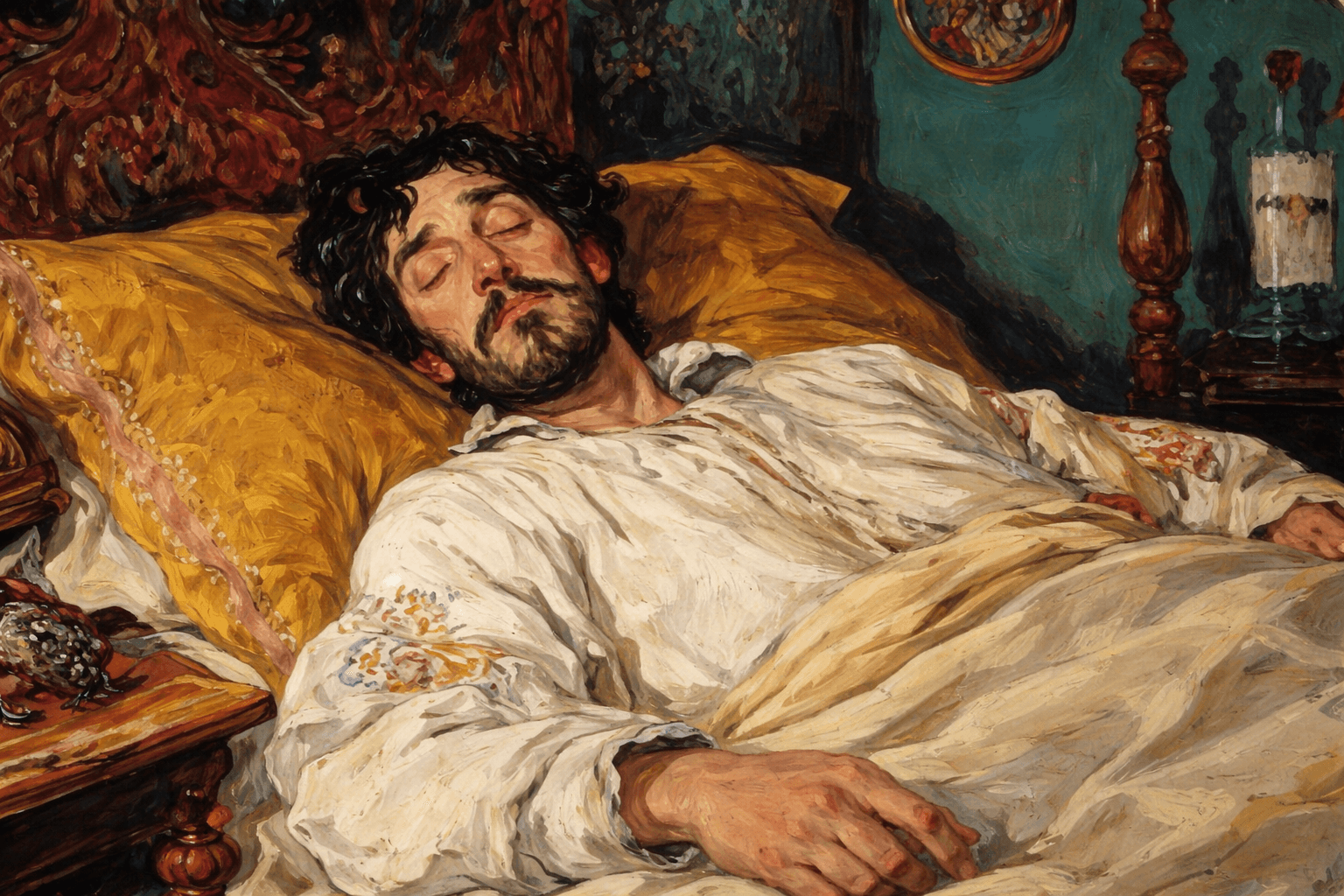
Ivan Ilyich on his death bed
Ivan Ilyich, Tolstoy's celebrated magistrate, has spent his lifetime suppressing precisely these affinities. He constructs his existence with the careful, joyless efficiency of a bureaucrat filing papers: the correct career, the correct wife, the correct furnishings in the correct drawing room. He belongs to the class of people for whom the performance of a life has entirely displaced the living of one. When he hangs the drapes in his new apartment, Tolstoy tells us he feels a particular pleasure, not the pleasure of beauty, but of conformity, of having arranged things "as people of a certain standing arrange them." There is no resonance here, only compliance.
Then the fall. Literally: a banal domestic accident while hanging curtains, that same apartment, those same performative drapes, leaves him with an internal injury that will not heal. The body, which social convention cannot discipline as thoroughly as the mind, begins its slow refusal. And it is in this dissolution, in the humiliating proximity of death, that something extraordinary happens. The masks begin to slip. Not all at once, and not without resistance. Ivan Ilyich fights it, retreating into denial, into irritation, into the bureaucratic fantasy that the right doctor, the right diagnosis, the correct procedure, will file the illness away and restore order. But the body does not comply. In his final hours, after an agonized confession to his son that he has lived badly, something releases. In slowly allowing the raw and authentic parts of himself to finally surface (the regret, the vulnerability), Ivan Ilyich steps, for the first time, into alignment.
This made me realize that the necessary condition for these affinities to crystallize into moments of alignment is that of authenticity. In accepting rather than concealing our inner nature, our identity unfolds as a collection of resonances that we have allowed to materialize. Allowing the raw, unique parts of themselves to surface in the external world, we become unanchored from static constructs of identity built around careers, interests, or hobbies. Our becomes a dynamic, living architecture, freely navigating the world in search of structures that may host the multiplicity of his resonances. In the spontaneous laugh that escapes us, the involuntary rush in our eyes when we recognise love, the inevitable worry in their pursuit of something bigger, our authentic pulse opens up a space, allowing us, for a brief moment, to be aligned.
BOOK REVIEW
The Death of Ivan Ilyitch
Milana Petrova
The Death of Ivan Ilyich is a short book about a man who wastes his life and dies. This summary is accurate and completely beside the point. What Tolstoy actually wrote is a precise, merciless account of what happens when a person never once asks themselves whether the life they are living is genuinely their own, and what it costs them when the body, finally, refuses to keep the secret.
The picture which the world presents to the naked human eye can hardly seem anything but a battleground of contradictions, with opposing forces colliding without apparent resolution. Yet, in brief moments, these conflicting parts seem to fold into a mysterious harmony, suddenly imbuing the image with a revealing clarity. An unusual eye color, the elegant design of a complex machine, or a moving piece of music, may evoke, in the observer, a lucid vision of coherence and meaning. As though teasing us, just as we fix our gaze on this hopeful picture, it quickly slips away. Let us call these ephemeral moments alignment.
I propose that the curious source of these alignments lies in pre-existent resonances between one’s inner nature and elements of the external world. To exemplify this, consider pieces on a mid-game chessboard. While a strategist may find himself immersed in the plurality of possible positions, an aesthete may instead be fascinated by the elegant finish of the bishop, a fantasist inspired by a cataclysmic battlefield, a chess player reflective on a lost game. These widely divergent responses are unique in all but one factor: they share an equal emotional wealth in the beholder. Suppose the fantasist were to adopt the strategists’ perspective and aim at winning the game. Their face would feign interest while the distant sounds of clashing swords would fill them with guilt for abandoning their loyal soldiers at such a crucial time. It is precisely this raw, instinctive correspondence between one’s inner landscape and the elements surrounding them that give rise to moments of alignment. Let us call these inherent connections affinities.
Ivan Ilyich on his death bed
Ivan Ilyich, Tolstoy's celebrated magistrate, has spent his lifetime suppressing precisely these affinities. He constructs his existence with the careful, joyless efficiency of a bureaucrat filing papers: the correct career, the correct wife, the correct furnishings in the correct drawing room. He belongs to the class of people for whom the performance of a life has entirely displaced the living of one. When he hangs the drapes in his new apartment, Tolstoy tells us he feels a particular pleasure, not the pleasure of beauty, but of conformity, of having arranged things "as people of a certain standing arrange them." There is no resonance here, only compliance.
Then the fall. Literally: a banal domestic accident while hanging curtains, that same apartment, those same performative drapes, leaves him with an internal injury that will not heal. The body, which social convention cannot discipline as thoroughly as the mind, begins its slow refusal. And it is in this dissolution, in the humiliating proximity of death, that something extraordinary happens. The masks begin to slip. Not all at once, and not without resistance. Ivan Ilyich fights it, retreating into denial, into irritation, into the bureaucratic fantasy that the right doctor, the right diagnosis, the correct procedure, will file the illness away and restore order. But the body does not comply. In his final hours, after an agonized confession to his son that he has lived badly, something releases. In slowly allowing the raw and authentic parts of himself to finally surface (the regret, the vulnerability), Ivan Ilyich steps, for the first time, into alignment.
This made me realize that the necessary condition for these affinities to crystallize into moments of alignment is that of authenticity. In accepting rather than concealing our inner nature, our identity unfolds as a collection of resonances that we have allowed to materialize. Allowing the raw, unique parts of themselves to surface in the external world, we become unanchored from static constructs of identity built around careers, interests, or hobbies. Our becomes a dynamic, living architecture, freely navigating the world in search of structures that may host the multiplicity of his resonances. In the spontaneous laugh that escapes us, the involuntary rush in our eyes when we recognise love, the inevitable worry in their pursuit of something bigger, our authentic pulse opens up a space, allowing us, for a brief moment, to be aligned.
BOOK REVIEW
The Death of Ivan Ilyitch
Milana Petrova
The Death of Ivan Ilyich is a short book about a man who wastes his life and dies. This summary is accurate and completely beside the point. What Tolstoy actually wrote is a precise, merciless account of what happens when a person never once asks themselves whether the life they are living is genuinely their own, and what it costs them when the body, finally, refuses to keep the secret.
The picture which the world presents to the naked human eye can hardly seem anything but a battleground of contradictions, with opposing forces colliding without apparent resolution. Yet, in brief moments, these conflicting parts seem to fold into a mysterious harmony, suddenly imbuing the image with a revealing clarity. An unusual eye color, the elegant design of a complex machine, or a moving piece of music, may evoke, in the observer, a lucid vision of coherence and meaning. As though teasing us, just as we fix our gaze on this hopeful picture, it quickly slips away. Let us call these ephemeral moments alignment.
I propose that the curious source of these alignments lies in pre-existent resonances between one’s inner nature and elements of the external world. To exemplify this, consider pieces on a mid-game chessboard. While a strategist may find himself immersed in the plurality of possible positions, an aesthete may instead be fascinated by the elegant finish of the bishop, a fantasist inspired by a cataclysmic battlefield, a chess player reflective on a lost game. These widely divergent responses are unique in all but one factor: they share an equal emotional wealth in the beholder. Suppose the fantasist were to adopt the strategists’ perspective and aim at winning the game. Their face would feign interest while the distant sounds of clashing swords would fill them with guilt for abandoning their loyal soldiers at such a crucial time. It is precisely this raw, instinctive correspondence between one’s inner landscape and the elements surrounding them that give rise to moments of alignment. Let us call these inherent connections affinities.
Ivan Ilyich on his death bed
Ivan Ilyich, Tolstoy's celebrated magistrate, has spent his lifetime suppressing precisely these affinities. He constructs his existence with the careful, joyless efficiency of a bureaucrat filing papers: the correct career, the correct wife, the correct furnishings in the correct drawing room. He belongs to the class of people for whom the performance of a life has entirely displaced the living of one. When he hangs the drapes in his new apartment, Tolstoy tells us he feels a particular pleasure, not the pleasure of beauty, but of conformity, of having arranged things "as people of a certain standing arrange them." There is no resonance here, only compliance.
Then the fall. Literally: a banal domestic accident while hanging curtains, that same apartment, those same performative drapes, leaves him with an internal injury that will not heal. The body, which social convention cannot discipline as thoroughly as the mind, begins its slow refusal. And it is in this dissolution, in the humiliating proximity of death, that something extraordinary happens. The masks begin to slip. Not all at once, and not without resistance. Ivan Ilyich fights it, retreating into denial, into irritation, into the bureaucratic fantasy that the right doctor, the right diagnosis, the correct procedure, will file the illness away and restore order. But the body does not comply. In his final hours, after an agonized confession to his son that he has lived badly, something releases. In slowly allowing the raw and authentic parts of himself to finally surface (the regret, the vulnerability), Ivan Ilyich steps, for the first time, into alignment.
This made me realize that the necessary condition for these affinities to crystallize into moments of alignment is that of authenticity. In accepting rather than concealing our inner nature, our identity unfolds as a collection of resonances that we have allowed to materialize. Allowing the raw, unique parts of themselves to surface in the external world, we become unanchored from static constructs of identity built around careers, interests, or hobbies. Our becomes a dynamic, living architecture, freely navigating the world in search of structures that may host the multiplicity of his resonances. In the spontaneous laugh that escapes us, the involuntary rush in our eyes when we recognise love, the inevitable worry in their pursuit of something bigger, our authentic pulse opens up a space, allowing us, for a brief moment, to be aligned.
Write a eulogy to something you love: contact@theneighborr.com
Write a eulogy to something you love:
contact@theneighborr.com