
BOOK REVIEW
Salammbô, Flaubert
Anna Kowalska
I began the year with Flaubert's Salammbô, inspired by his adventures in the Near East. I don’t think we have visited the same holiday resorts. Form-fitting tunics, oiled and muscle-bound Maciste figures in sandals, princesses baring their navels and made up like Nina Hagen, none of this appeals to me. And yet, for all that, I consider it a literary masterpiece.
From the opening lines, the tone is established. It is at once disarmingly simple, remarkably poetic, and lavishly exotic. Listen closely, for Flaubert offers the singular pleasure of reading aloud: "It was at Megara, a suburb of Carthage, in the gardens of Hamilcar." It sounds like the beginning of a fable, with this resonant and harmonious sentence that rings like a haiku and compels you to turn the page. It is an immense novel, like the elephants that traverse its pages, crushing everything in their path. Flaubert's imagination here reaches its zenith. A tempest of images. An avalanche of sensations, emotions, consuming passion.
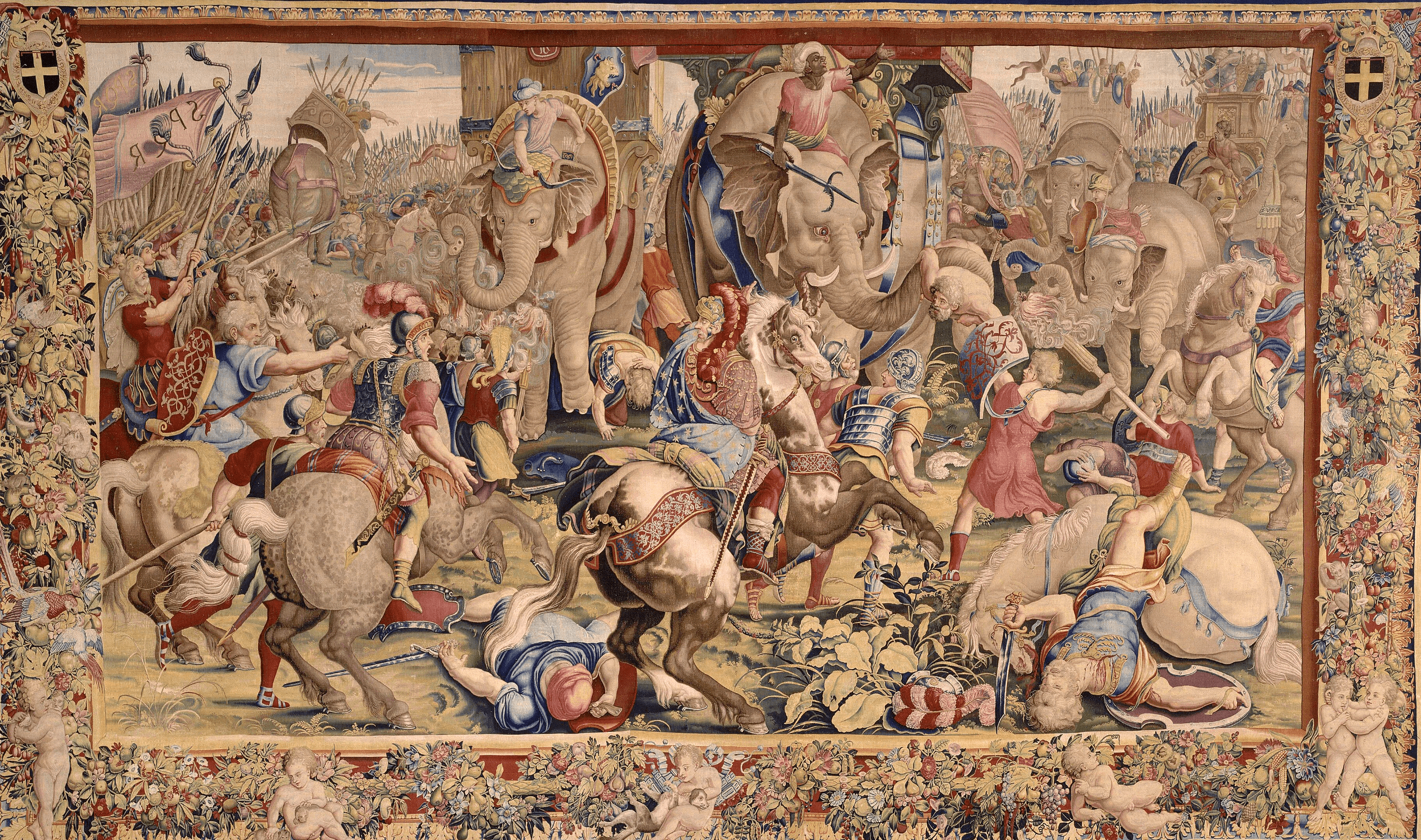
The Battle of Zama, 1688-1689
Let me briefly outline the plot. We are in the third century BC, following the First Punic War. The wealthy merchants of Carthage, more preoccupied with their fortunes than with the city itself, refuse to pay what they owe the mercenary army that fought valiantly against Rome alongside Hamilcar, the greatest of Carthaginian generals. The mercenaries thus resolve to revolt and besiege the city. Feeling themselves victims of injustice, aggrieved and dishonored, these formidable soldiers lay waste to Hamilcar's estates before the eyes of Salammbô, the general's daughter and priestess of Tanit, goddess of the Moon, who attempts to pacify them. One man, the mercenary leader, the Libyan Mâtho, falls desperately in love with this divine virgin. From this encounter springs a fatal bond that will plunge all into war: a pitiless war for power, for Carthage, for Salammbô herself. After this, every love scene you encounter in other novels will seem decidedly pallid.
It is a narrative of tremendous savagery. Flaubert's language, in its precision, exists to articulate the unspeakable. In this catastrophe and delirium, Salammbô embodies not merely passionate love, she is a femme fatale, accursed, like those figures from mythology whose beauty and enigma sparked wars and precipitated the collapse of empires. How can one not think of Helen, of the Trojan War, of the Iliad? There is an exactitude to the prose; it reads like a lyric poem, a kind of opera, a peplum rendered in poetic prose, language suffused with fragrance and color to express horror, warfare, human madness. The luminous beauty of Salammbô's prose is timeless. It is as intoxicating and devastating as the armies that clash beneath the Carthaginian sun for Salammbô.
BOOK REVIEW
Salammbô, Flaubert
Anna Kowalska
I began the year with Flaubert's Salammbô, inspired by his adventures in the Near East. I don’t think we have visited the same holiday resorts. Form-fitting tunics, oiled and muscle-bound Maciste figures in sandals, princesses baring their navels and made up like Nina Hagen, none of this appeals to me. And yet, for all that, I consider it a literary masterpiece.
From the opening lines, the tone is established. It is at once disarmingly simple, remarkably poetic, and lavishly exotic. Listen closely, for Flaubert offers the singular pleasure of reading aloud: "It was at Megara, a suburb of Carthage, in the gardens of Hamilcar." It sounds like the beginning of a fable, with this resonant and harmonious sentence that rings like a haiku and compels you to turn the page. It is an immense novel, like the elephants that traverse its pages, crushing everything in their path. Flaubert's imagination here reaches its zenith. A tempest of images. An avalanche of sensations, emotions, consuming passion.
The Battle of Zama, 1688-1689
Let me briefly outline the plot. We are in the third century BC, following the First Punic War. The wealthy merchants of Carthage, more preoccupied with their fortunes than with the city itself, refuse to pay what they owe the mercenary army that fought valiantly against Rome alongside Hamilcar, the greatest of Carthaginian generals. The mercenaries thus resolve to revolt and besiege the city. Feeling themselves victims of injustice, aggrieved and dishonored, these formidable soldiers lay waste to Hamilcar's estates before the eyes of Salammbô, the general's daughter and priestess of Tanit, goddess of the Moon, who attempts to pacify them. One man, the mercenary leader, the Libyan Mâtho, falls desperately in love with this divine virgin. From this encounter springs a fatal bond that will plunge all into war: a pitiless war for power, for Carthage, for Salammbô herself. After this, every love scene you encounter in other novels will seem decidedly pallid.
It is a narrative of tremendous savagery. Flaubert's language, in its precision, exists to articulate the unspeakable. In this catastrophe and delirium, Salammbô embodies not merely passionate love, she is a femme fatale, accursed, like those figures from mythology whose beauty and enigma sparked wars and precipitated the collapse of empires. How can one not think of Helen, of the Trojan War, of the Iliad? There is an exactitude to the prose; it reads like a lyric poem, a kind of opera, a peplum rendered in poetic prose, language suffused with fragrance and color to express horror, warfare, human madness. The luminous beauty of Salammbô's prose is timeless. It is as intoxicating and devastating as the armies that clash beneath the Carthaginian sun for Salammbô.
BOOK REVIEW
Salammbô, Flaubert
Anna Kowalska
I began the year with Flaubert's Salammbô, inspired by his adventures in the Near East. I don’t think we have visited the same holiday resorts. Form-fitting tunics, oiled and muscle-bound Maciste figures in sandals, princesses baring their navels and made up like Nina Hagen, none of this appeals to me. And yet, for all that, I consider it a literary masterpiece.
From the opening lines, the tone is established. It is at once disarmingly simple, remarkably poetic, and lavishly exotic. Listen closely, for Flaubert offers the singular pleasure of reading aloud: "It was at Megara, a suburb of Carthage, in the gardens of Hamilcar." It sounds like the beginning of a fable, with this resonant and harmonious sentence that rings like a haiku and compels you to turn the page. It is an immense novel, like the elephants that traverse its pages, crushing everything in their path. Flaubert's imagination here reaches its zenith. A tempest of images. An avalanche of sensations, emotions, consuming passion.
The Battle of Zama, 1688-1689
Let me briefly outline the plot. We are in the third century BC, following the First Punic War. The wealthy merchants of Carthage, more preoccupied with their fortunes than with the city itself, refuse to pay what they owe the mercenary army that fought valiantly against Rome alongside Hamilcar, the greatest of Carthaginian generals. The mercenaries thus resolve to revolt and besiege the city. Feeling themselves victims of injustice, aggrieved and dishonored, these formidable soldiers lay waste to Hamilcar's estates before the eyes of Salammbô, the general's daughter and priestess of Tanit, goddess of the Moon, who attempts to pacify them. One man, the mercenary leader, the Libyan Mâtho, falls desperately in love with this divine virgin. From this encounter springs a fatal bond that will plunge all into war: a pitiless war for power, for Carthage, for Salammbô herself. After this, every love scene you encounter in other novels will seem decidedly pallid.
It is a narrative of tremendous savagery. Flaubert's language, in its precision, exists to articulate the unspeakable. In this catastrophe and delirium, Salammbô embodies not merely passionate love, she is a femme fatale, accursed, like those figures from mythology whose beauty and enigma sparked wars and precipitated the collapse of empires. How can one not think of Helen, of the Trojan War, of the Iliad? There is an exactitude to the prose; it reads like a lyric poem, a kind of opera, a peplum rendered in poetic prose, language suffused with fragrance and color to express horror, warfare, human madness. The luminous beauty of Salammbô's prose is timeless. It is as intoxicating and devastating as the armies that clash beneath the Carthaginian sun for Salammbô.
Write a eulogy to something you love: contact@theneighborr.com
Write a eulogy to something you love:
contact@theneighborr.com